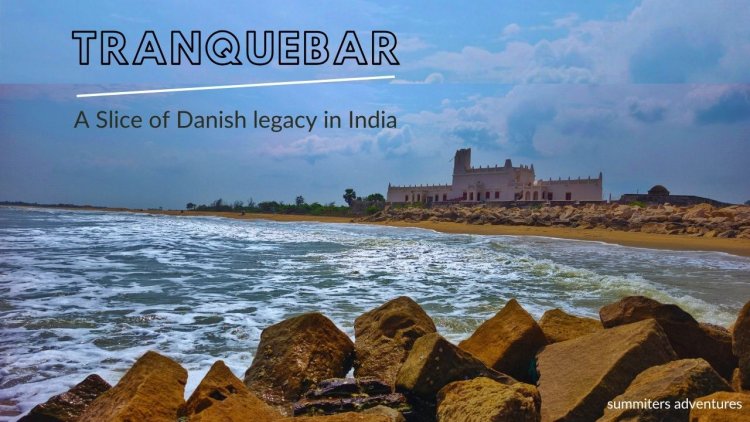
Tranquebar : A slice of Danish Legacy in India
If you are looking for an offbeat tranquil coastal getaway with rich heritage down south, then Tranquebar (officially known as Tharangambadi) might interest you. Having an interesting history. It is a place for slow travelers. If you feel that this place meets your requirements then it's a place that you must visit. There are, thankfully, no noisy pubs, no beaches stuffed with loud ‘tourists’, no restaurants, not yet. Known the thickest ozone layer in India and never-ending ocean views, there’s no dearth for reasons as to why this special place needs to be on your bucket list. Only song of Waves to keep your senses Alive !
 Vishwanath Radhakrishna
After a week-long temple run from Madurai, traveling down south I finally landed at Karaikal one fine afternoon. The weather didn't seem to change !. Though the accu weather cautioned me of thunderstorms and heavy rain, their was no trace of it and the scorching heat with humidity remained the same !
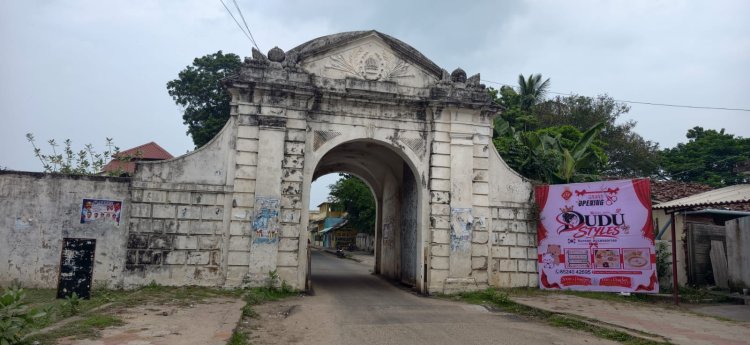
The green paddy fields on the either side was pleasing to eyes. Finally after a short drive of 30 minutes on the East Coast Road popularly known as ECR , brought me to Tranquebar !. As I passed through the arch, a Town Gate, built in 1792 was once an integral part of the fortified place of Danish settlement
The structures here reminded me of my visit to the bright French colony of Puducherry. Since my journey was culminating at a coastal town. My overnight stay too was planned accordingly.
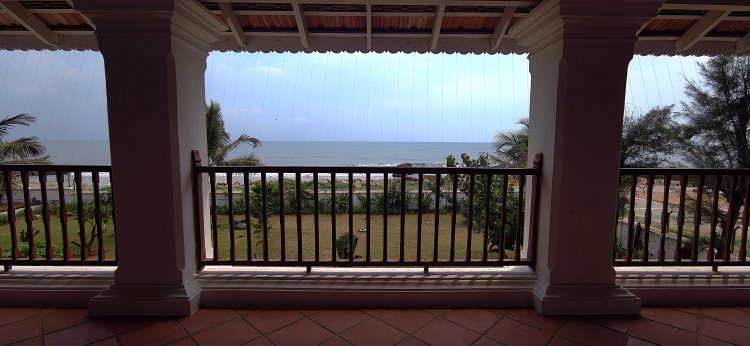
It was none other than a Bungalow on Beach located strategically overlooking the sea.
It was time to explore the centuries of Danish history with India. I had heard of Tranquebar decades back and visualised it as I passed through the alleys !
It was around noon and the harsh sun made me feel as if I would swoon anytime. After a quick lunch and a siesta, I felt refreshed. A sign board guided me to all the attractions of the Danish colony which were close to each other.
I walked to Dansborg Fort and the location seemed .strategically planned with high ramparts facing sea.
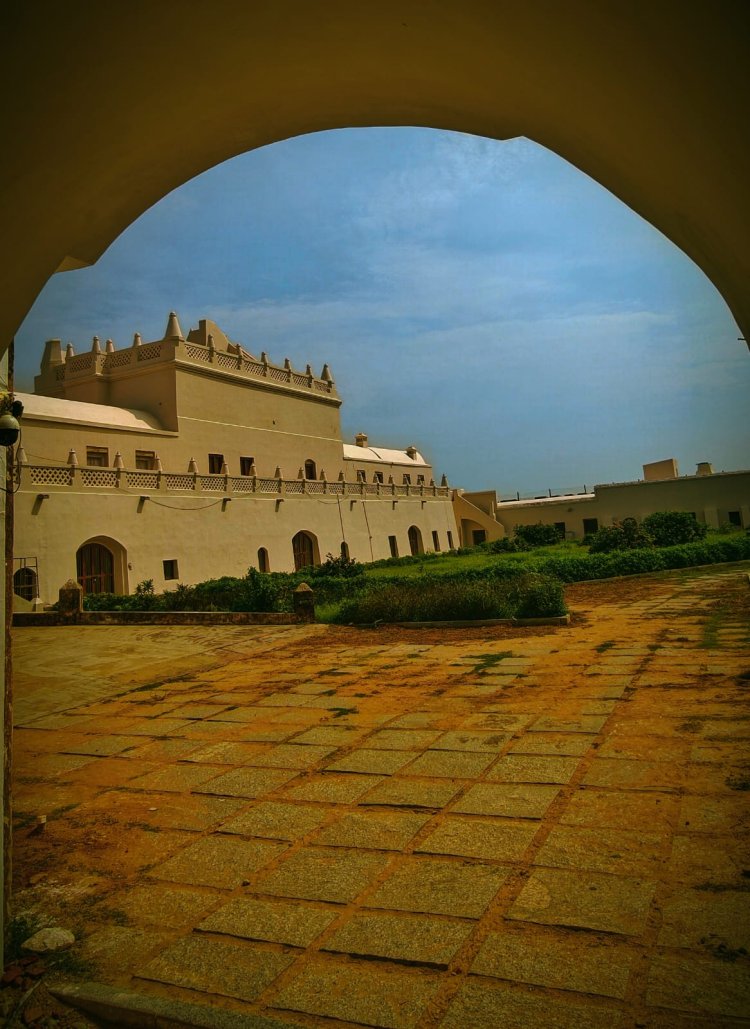
I gained entry after paying Rs 5 /- as entry fee.I felt UPI works here or a scanner for payment. But caretaker was liberal to allow me without asking a entry fee. ( Please carry small denominations with you ). The North gate had fortifications and some huge columns, it resembled french architecture !
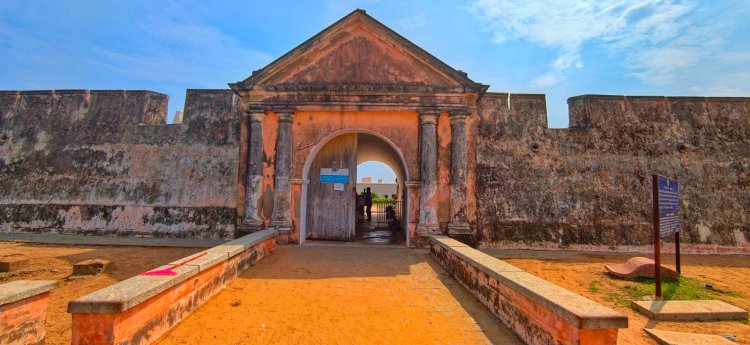
The heat waves and humidity makes one tired.It is recommended to visit before summer sets in. Dont forget to wear a sun cap or go armed with a umbrella for company. But the weather is unpredictable here. In Spite of all challenges I set out solo to explore the Danish attractions and historical sights on foot. Finally the signboards led me to the ramparts of the fort, facing sea. The giant cannons, guarding the fort from the intruders looked awesome !. Danish Fort of Tharangambadi (Fort Dansborg)
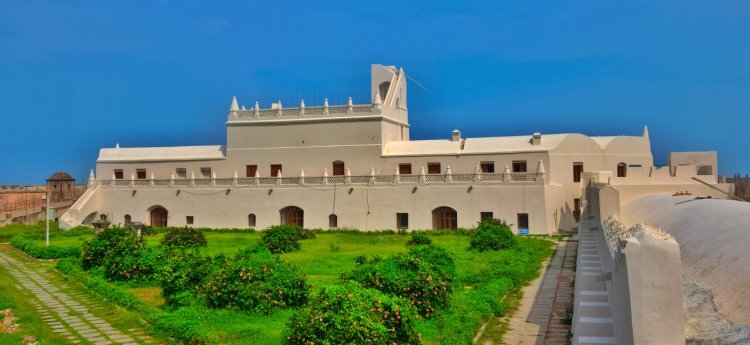 I came to know that when Danes signed the treaty in 1620, it was evident that there would be an influx of Danish officials and their families traveling to Tranquebar. About 300 - 400 people including soldiers arrived from Denmark and they needed a place to stay. However, Admiral Gjedde had a different idea. He built a Danish Fort in Danish-style trapezoidal-shaped fort with the help of the then King and labour for construction. It is a column-structured, two-tiered building with a dome; built of brick and mortar in classic Danish architecture. Fort Dansborg built on the sleepy shores of Tranquebar, overlooks the Bay of Bengal and offers a fabulous view from the upper floor.
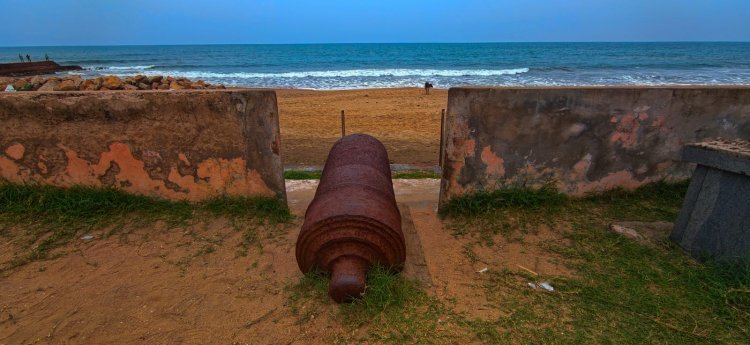
Canon at Danish Fort Dansborg facing the Bay of Bengal
I could see at the entrance few rooms, barracks, living rooms for soldiers and other staff as well as prison. Now all locked for visitors !. The fort has a big garden in the center and two wells for drinking water. There is a huge periphery that is accessed from the upper floor for the guards to keep any eye on the fort as well as the surrounding. I walked through it and had some uninterrupted views !
The Tsunami of 2004 damaged the citadel walls and other structures of the fort followed by restoration work in 2005 and again later in 2011.
It was disappointing for me after hearing that museum was closed for maintaince work. Without a second thought i sat gazing at sea watching sea gulls hovering around and taking a plunge to catch the fish.
Governors Bungalow at Tharanagambadi Just opposite to the entrance of fort is a eye catching colourful structure built for then Governing officer. This beautiful European bungalow painted in yellow with large windows and tall pillars along the verandah. The colonial house is said to be the Governor's Bungalow and a private residence in those days. It has been declared as a heritage property, restored now, by INTACH usually kept locked. I just a board mentioning it as a protected monument. It is a place now for street dogs to rest.
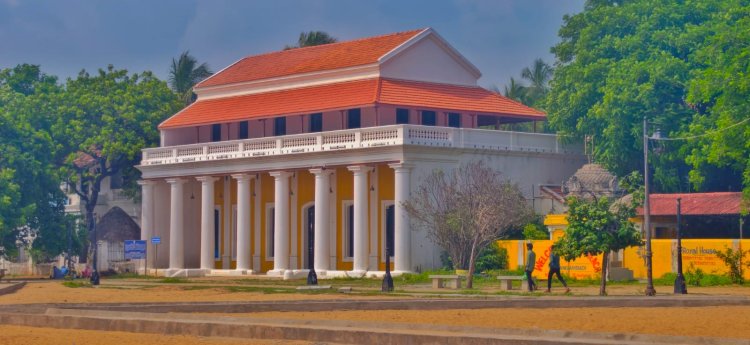
The colonial bungalow, built in 1793 functioned as District Court in 1884 after Tranquebar was sold to British in 1845
Tharangambadi - Tranquebar – Trankebar
Apparently, the name Tharangambadi itself means ‘the land of singing waves’, which is very synonymous for the village because of the constant sound of the sea that provides background music throughout the streets of Tranquebar all day and night . As per popular legend, Tranquebar was a name coined by the Scandinavians because they had huge difficulty in pronouncing Tharangambadi. This quaint seaside town on the Coromandel post was once the trading post of the Danish East India Company.
History of Tranquebar
In the early 17th Century; Denmark set up an East India Company to enable them to trade with the sub-continent. They sent a fleet of ships to Ceylon (Sri Lanka) and India, which first landed in Tanjore. The Danes requested the ‘King of Tanjore’ to let them establish a settlement on the coast in return for an annual tribute.
A large part of Tranquebar village was damaged due to the tsunami in 2004. With the help of Tamil Nadu State Archeological Department and the Royal Danish family, the Danish Tranquebar Association has managed to restore some parts of Tranquebar.
As I walked through the alleys I was fascinated by the aquamarine waters juxtaposed against picture perfect beaches, quaint streets lined with colourfully-painted old homes and the feeling of time having stood still for centuries. As a solo traveler it is quite a common feeling that I experienced here too; the fact that this was an erstwhile Danish colony for more than 2 centuries !
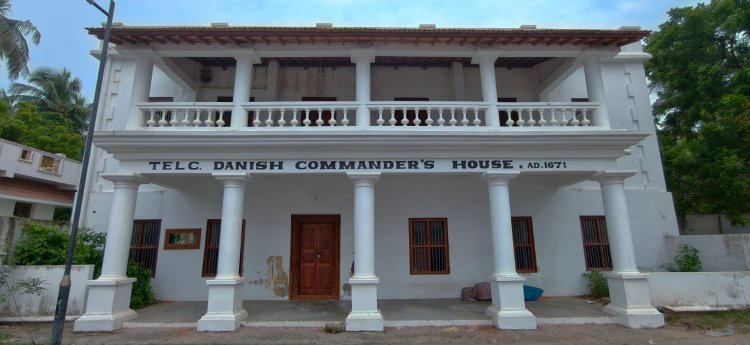
As I walk through, the Caammanders house, ‘Halkier’s House’ which is an 18th Century structure. The entire King’s Street, which connects the gateway of Tranquebar and the beach, is full of monuments and sites that showcase Scandinavian influences.
Ziegenbalg statue in front of his residence converted now into Tranquebar Maritime Museum and Danish-India Cultural Centre in 2006 to celebrate 300th anniversary of his arrival in Tranquebar
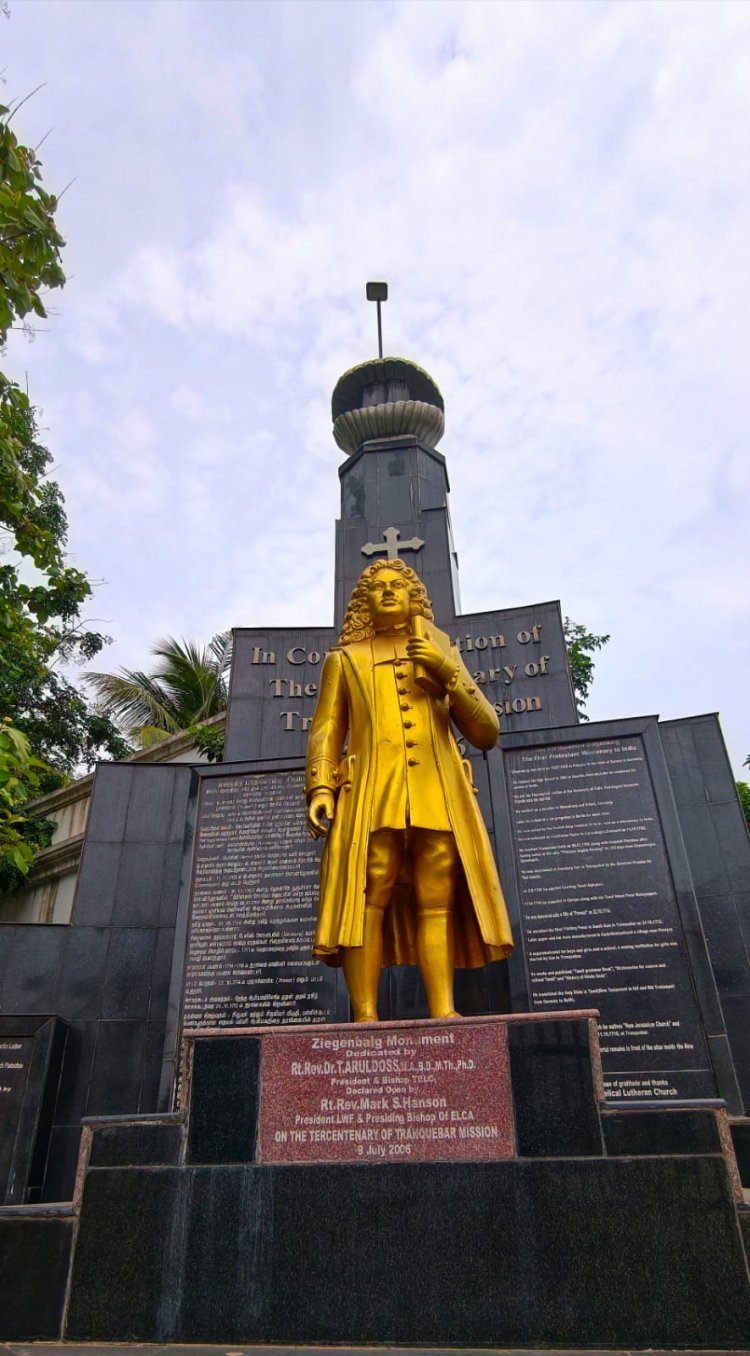
Also, if you take a walk across Tranquebar; the town still retains its classical streetscape and old names : King’s Street, Queen’s Street, Admiral Street, Goldsmith Street, Mosque Street, etc.The local administration has done a good job with the sign boards and life in Tranquebar surely does feel like walking back in the past. Zion Church
The Zion Church was consecrated in 1701 and is the last building on King’s Street. It lies inside a lovely compound with greenery and seems to have been well maintained with constant renovations. Inside the church, polished brass plaques on the wall signify that the first five Indian protestant converts of the Danish mission were baptized in Zion church in the year 1707.
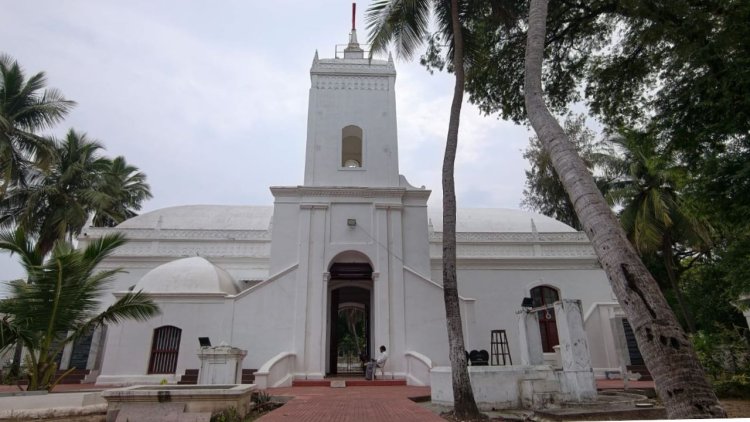
Diagonally opposite to Zion on the same street is the New Jerusalem church.It is said that since, Zion Church declined to accept native converts to worship, Ziegenbalg decided to raise money and set up another church. The foundation for the Jerusalem Church was laid on June 14, 1707. It became very popular in no time and was filled to capacity and the premises needed to be expanded.
New Jerusalem Church
The Jerusalem Church was built in 1707 and the New Jerusalem Church was built in 1718 on King Street to accommodate more people. It is the oldest and first protestant Lutheran church of India and is definitely the prettiest of all the churches in Tranquebar. The New Jerusalem Church was built in a mix of architectural styles by missionaries Bartolomäus Ziegenbalg and Heinrich Plütschau in 1718.
Church is the prettiest church in Tranquebar, with imposing architecture and has an elaborate and detailed list of Danish pastors and priests inside.
Famous personality, Ziegenbalg died in New Jerusalem Church in 1719 and was buried here as well. His tombstone is also in the same place. Ziegenbalg’s contribution to the Danish history in Tranquebar has been immense. He even learnt the local language Tamil and translated the Bible in Tamil.
There are a lot of burials within the church premises, and some have epitaphs in Danish language as well.
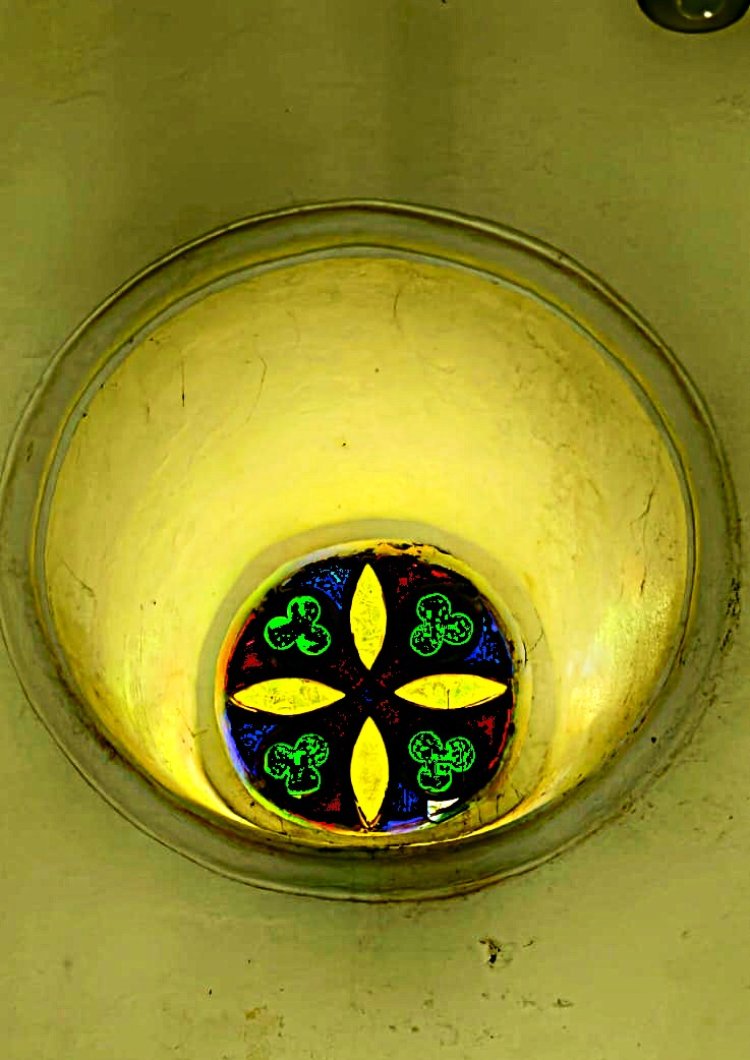
The circular Stained glass work on the eastern walls was a sight to behold. The art form transforms natural sunlight into vibrant hues, symbolizing the presence of the divine and creating a meditative, sacred atmosphere inside the prayer hall
I walked upto the harbour, i could see the life of fisherman and dock workers busy at work. Men folk fixing torn nets.Women folk secregating the prized catch, fish, Giant Sting rays, crabs, Cuttle fish, squid and shrimps of various size ! 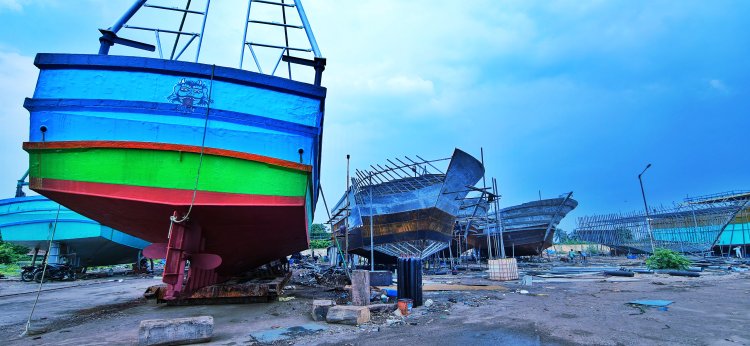
―
Sri Masilamani Nathar temple
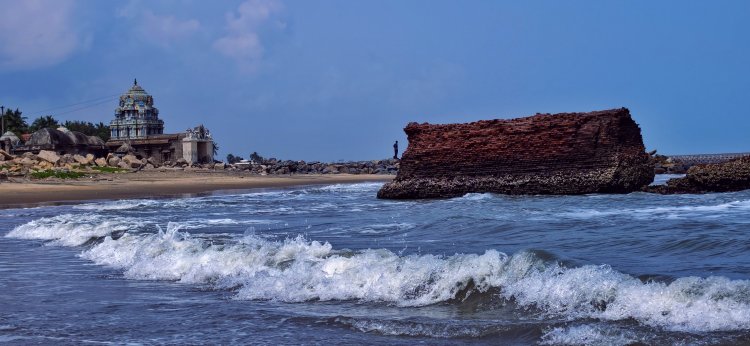
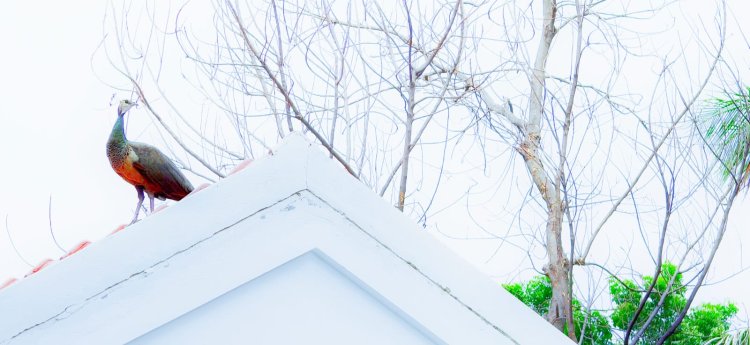
It is said to be the oldest man made structure in Tharangambadi, centuries before Danes arrived. A temple dedicated to Lord Shiva that holds huge pride among the locals had some of its parts destroyed during the Tsunami which brought it closer to the ocean. It is a popular tourist place in Tharangambadi.It is opened in the morning for devotees.I could see few butterflies including common leopord, and see and hear the call of peacock from our room patio.
The temple with colourful gopuram and stucco facing sea is an ideal place to watch the sea and waves lapping the rocks.
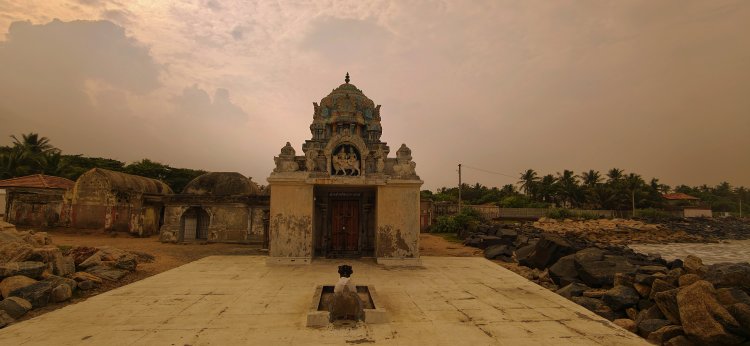
Also known as Manivaneswaram, it was built by Maravarman Kulashekhara Pandian in 1306
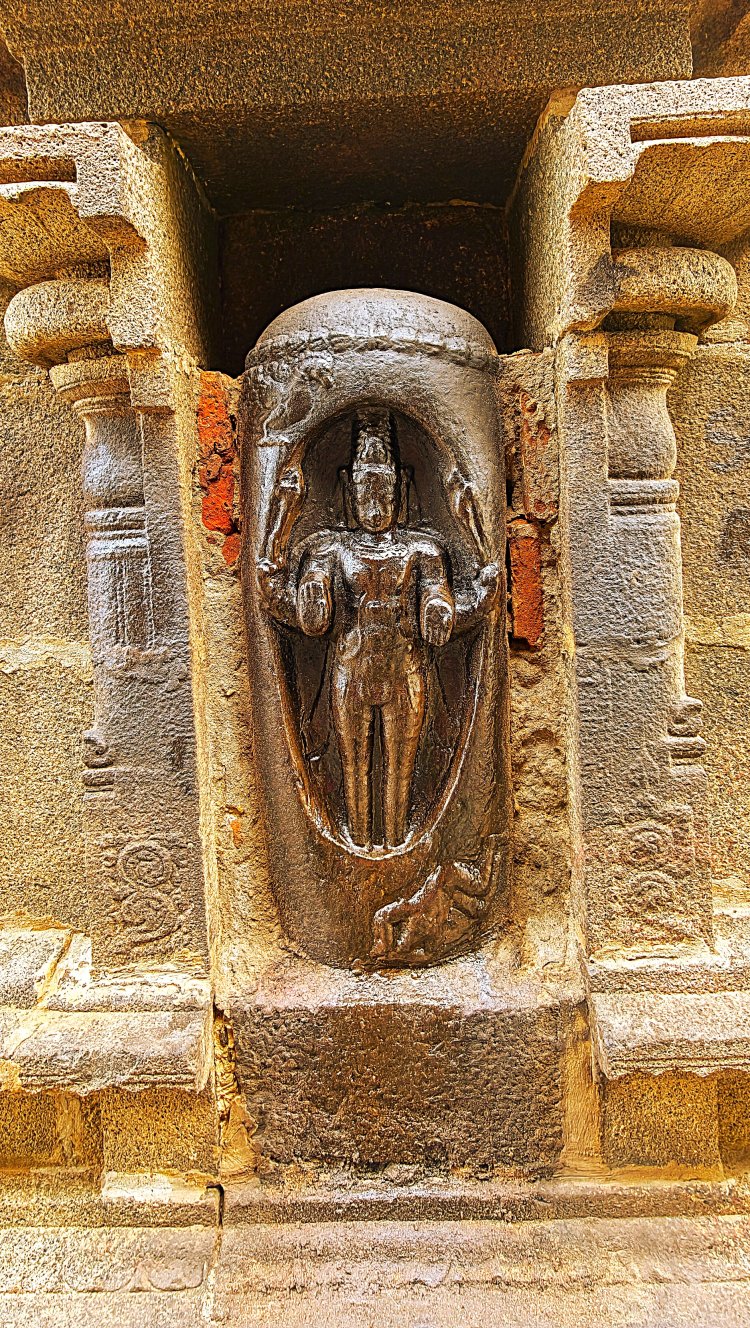 Ocean vibes are the best when you walk around the temple as the waves hit the rock structures resounding into the sea. A walk down the rock bridge is Tharangambadi beach specialty. A great evening pastime is sitting on the rock and feeling the waves hit you with moisture. A glimpse of rising sun is a memorable sight to behold !
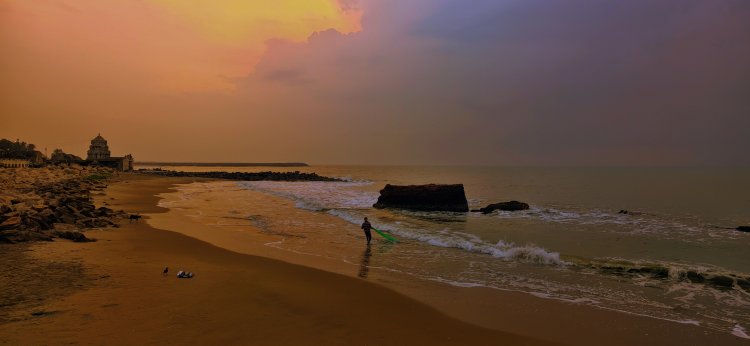
Bungalow on the Beach
Said to be the paradise on beach with view of sea. A dreamy location of the 17th Century Dansborg Fort on one side and the azure blue of the Bay of Bengal on the other, this heritage structure is my most prominent memory of Tranquebar.
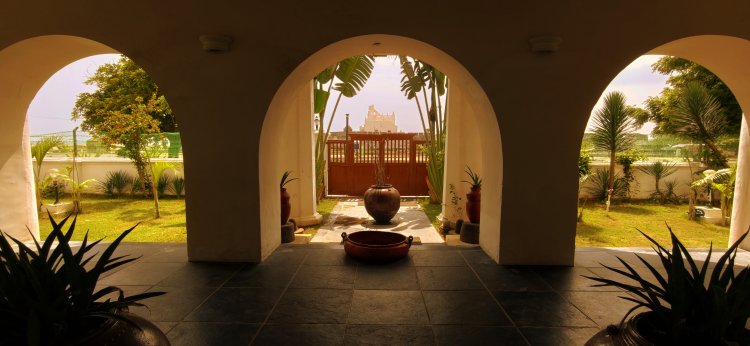
It is said that In their reign, it functioned as the summer residence of the British collector. Subsequently, the ‘Bungalow on the Beach’ fell into active disrepair, until it was acquired by Neemrana Group in 2002. After extensive restorations it was converted into a Heritage non-hotel.
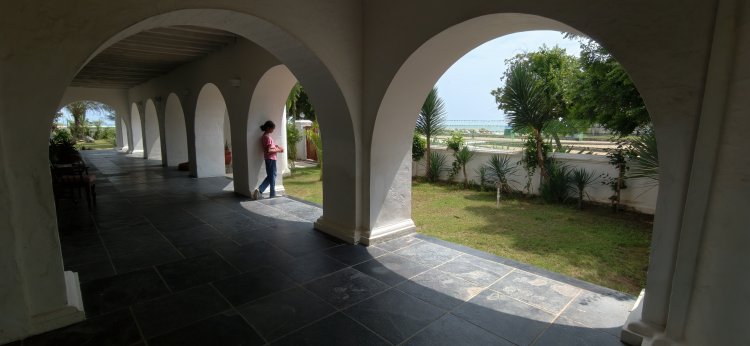
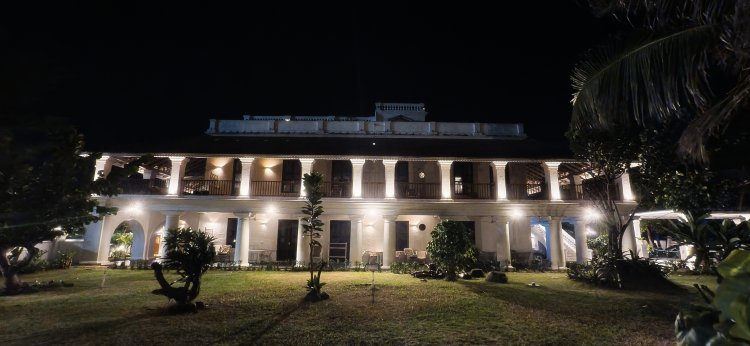
An interesting feature of the property is that the rooms are named after the Danish Ships that landed in Tranquebar.
I stayed in Queen Anna Sophia overlooking the sea.on the first floor !
The other rooms namely Prince Louis, Price Christian, Christianus Septimus, Crown Prince of Denmark and Countless Moltke.
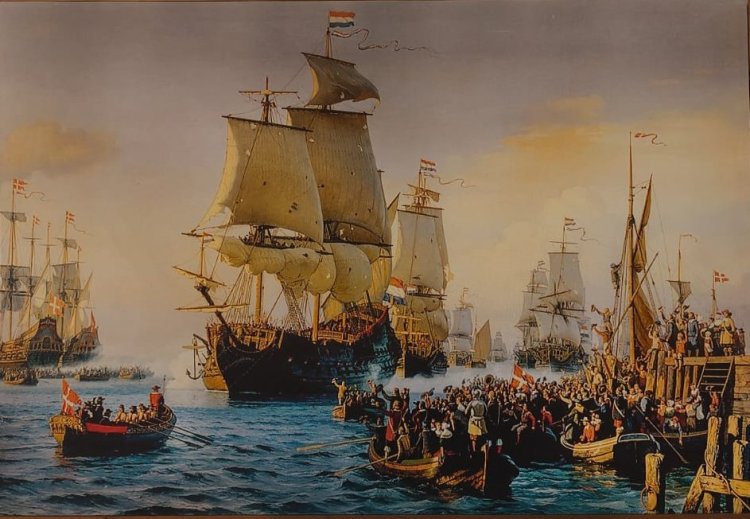
There are 2 rooms on ground floor, garden facing too. Elephant, Oldenberg,
The rooms had wall paintings of ships, the restrooms with traditional dress and caps worn by men. In the corridor pictorial representation of species of marine life !. Eel, Fishes, Pictorial maps...etc
I felt blessed to be sitting in the corridor and watching waves lashing the rocks and song !.It even rained a bit in the evening and it was a sheer joy in solitude.
After spending a night at Heritage NON HOTEL, i felt that money is vital, but temporary, can be earned back, while shared experiences and time become permanent parts of who you are.................!
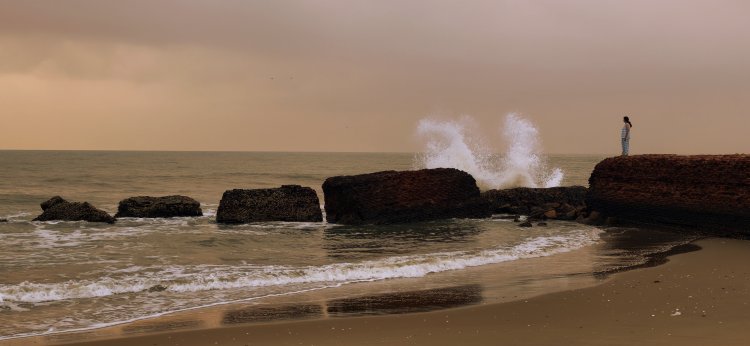
Best was to keep you engaged during visit to coromandel coast
Tranquebar Beach
Just adjacent to Dansborg Fort, the promenade leading to the beach can give a complex to the one the best sand beds.Endless expanse of blue. Strolling on the Tranquebar beach with endless views of the Sea has to be one of the must-do things when you visit this ‘land of singing waves!’
1. Watch Sunrise, and witness the colors and the changing colors of the sky without judging your thoughts
2. Wake up for the early morning or catch the late afternoon golden hour when the crowds are gone and the temperature is cool
3. Control yourself with rhythmic breathing with the sound of the ocean waves
How to reach Tranquebar?
Tranquebar is located at a distance of 280 kms from Chennai and 120 kms from Pondicherry. There are regular buses that run via ECR (East Coast Road) to Karaikal. Tharangambadi is the local Tamil name that is more widely used and it is quite possible that the locals haven’t even heard of Tranquebar. It is a very small town on the coast with limited population and fishing is the main occupation of the locals here.
Nearest Raihead
Distance from Karaikal to Tharangambadi is around 10 kms and Mayiladathurai 15 kms away.
Distance from Thanjavur to Tranquebar is 100 kms, and from Chidambaram – Tranquebar is 50 kms away.
Trichy (Tiruchirapalli) is approx. 150 kms away from Tharangambadi.